REVIEW · HAMBURG
Down Town to Speicherstadt, HafenCity and Elbphilharmonie
Book on Viator →Operated by Schoenes Hamburg · Bookable on Viator
Port history starts right at Rathausmarkt. This walk pulls together Hamburg’s trading power at Hamburg Town Hall and the city’s water story at Hygieia-Brunnen, then links you to the port districts so the sights feel like one connected story. The only catch: the route is compact and you’ll keep moving, so if you prefer long pauses between stops, build in time for a breather.
What I like most is the way the guide turns big city scenes into concrete details: what merchants did, how the harbor changed, and why certain buildings still matter. And you get a strong end payoff at the Elbphilharmonie—with a chance to step onto the platform and look out over the port.
If you want a walk that’s heavy on context (not just photos), this one works well. With a small group size capped at 15, you’re less likely to feel like a number, and the English narration is easy to follow even when the streets get busy.
In This Review
- Key things I’d mark on your map
- Rathausmarkt first: Town Hall and the water clue at Hygieia-Brunnen
- Trostbrücke and Deichstraße: where the port met the merchants
- St. Nikolai memorial: remembrance plus a history lesson in the ruins
- HafenCity: Europe’s largest city planning project explained on foot
- Speicherstadt: red-brick warehouses, wooden piles, and UNESCO weight
- Elbphilharmonie finish: a concert hall with a port-facing viewpoint
- Price and timing: what you’re really paying for
- Weather, pace, and how to get the best out of the walk
- If you get Jutta as your guide, you’ll feel the difference
- Should you book this Hamburg walking tour?
- FAQ
- How long is the tour?
- Where does the tour start and end?
- What language is the tour offered in?
- Do I need printed tickets?
- How big are the groups?
- Does the tour run in bad weather?
- What’s included in the price?
- Can I cancel for a full refund?
Key things I’d mark on your map
- Rathausmarkt start at the Neorenaissance Hamburg Town Hall, an immediate sense of civic power
- Trostbrücke (Consolation Bridge) framed as the starting point of Hamburg’s port story
- Operation Gomorrha exhibit beneath the St. Nikolai memorial ruins
- HafenCity’s scale explained in plain terms (157 hectares of transformation)
- UNESCO Speicherstadt with red-brick warehouses on wooden piles
- Elbphilharmonie finishing view from the platform over the harbor
Rathausmarkt first: Town Hall and the water clue at Hygieia-Brunnen
You kick things off at Rathausmarkt, right by the Hamburg Town Hall. Even from the outside, it’s a big clue about who ran this city and why. The building dates to 1897 and wears a Neorenaissance façade that signals the wealth and ambition of a trading powerhouse. It’s a good opener because it sets the tone: Hamburg didn’t grow by accident. It grew by planning, shipping, and yes, money.
Just behind the Town Hall is the Hygieia-Brunnen, and that’s not a random fountain stop. It represents the importance of fresh water—exactly the kind of practical detail a port city depends on. When you get the water context early, later stops hit harder, because you can see how the city’s infrastructure and trade systems go together.
If you’re the type who enjoys architecture but gets bored when it turns into vague descriptions, this start is helpful. You’re not only looking at pretty stone. You’re learning what the city had to solve to keep commerce running.
Other harbor and port cruises in Hamburg

Trostbrücke and Deichstraße: where the port met the merchants
From the Town Hall area, the walk moves toward Trostbrücke (listed here as Consolation Bridge). This is the origin point of the port story in central Hamburg. It’s easy to think of a port as something out at the docks, but Trostbrücke is presented as the place where sailing ships brought goods into the city center—merchants waiting to buy, sell, and move those goods onward.
What I appreciate is the timeline you get at street level. The guide explains how the harbor changed when steam ships and container vessels took over. You can think of it like this: the shipping technology changed, so the city had to change too—where goods arrived, how they moved, and even how the waterfront and warehouses evolved.
Next comes Deichstraße, a historic street where you can still picture how traders lived and worked in the same merchant homes. That’s a detail worth slowing down for. In many European port cities, the work and the living space got separated over time. Here, you’re shown the older pattern, including how goods storage, daily life, and business overlapped. The street also survived major disasters—fire in 1842 and WWII—so when you look at the buildings now, you’re looking at continuity after disruption.
Practical tip: take a couple of minutes to stand where the street opens up toward the harbor direction (even if you can’t see everything yet). It helps your brain connect Deichstraße to the shipping action described for Trostbrücke.
St. Nikolai memorial: remembrance plus a history lesson in the ruins
Not far from the merchant-and-port vibe, the tone shifts at the Mahnmal St. Nikolai. The steeple dates to 1874 and the memorial marks victims of WWII. But the part that tends to land with people is that the ruined space isn’t only about looking back—it also includes an exhibition underneath about Operation Gomorrha.
Operation Gomorrha matters because it explains why Hamburg’s built environment looks the way it does today. When you later see areas like HafenCity and Speicherstadt restored and redesigned, you understand the scale of what had to be rebuilt and reimagined. The memorial acts like a bridge between the old mercantile city and the modern one.
This stop is also a reminder that memorial spaces are not sightseeing props. You’ll get more from it if you take a calm minute rather than rushing for a quick photo. Even if you’re not a museum person, the ruined church + exhibit combo gives you a grounded understanding of the city’s 20th-century turning points.
HafenCity: Europe’s largest city planning project explained on foot
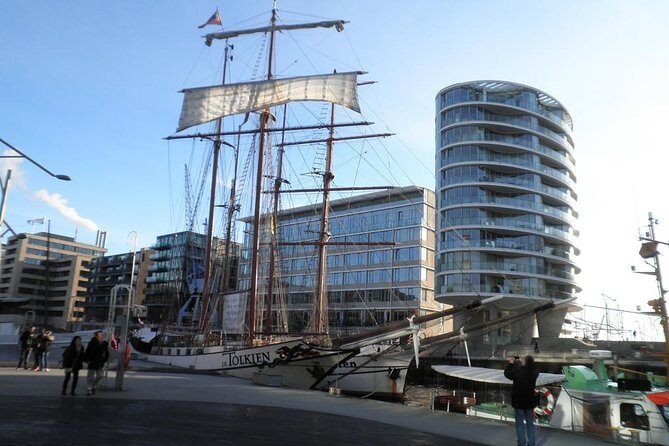
Now you move into HafenCity, described as Europe’s largest city planning project. The guide frames it as a transformation story: 157 hectares of former industrial area turned into a new district. That’s a huge number, and walking helps you grasp what “development at scale” feels like. You’re not just hearing that it grew—you’re seeing the shape of what planners created.
This part of the tour is especially valuable if you like city design and want more than a postcard view. HafenCity is the kind of place where the streets, waterways, and architecture all work together, and the guide’s job is to translate that planning into human terms: what changed, what replaced industrial space, and how the port’s legacy still shows up in the layout.
A practical note: HafenCity is part of the modern Hamburg fabric, so if you’re sensitive to wind off the water, it’s smart to have a layer. The tour runs in all weather, but your comfort matters when you’re out for about two hours.
Speicherstadt: red-brick warehouses, wooden piles, and UNESCO weight
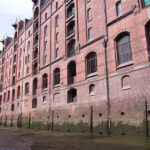
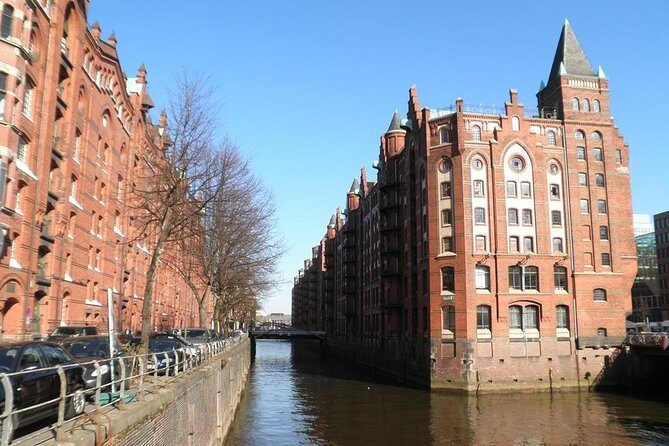
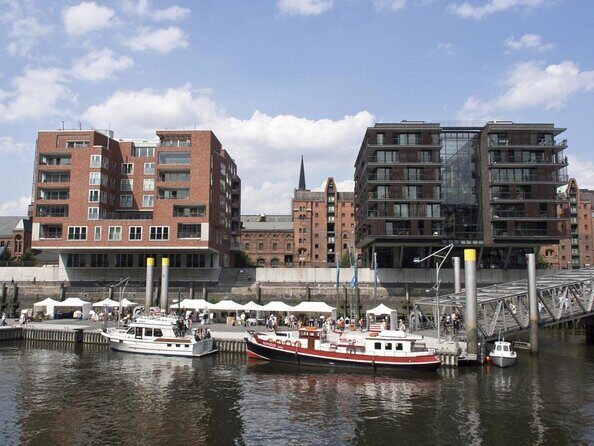
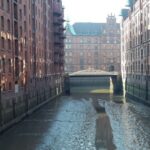
Next up is Speicherstadt, widely known as the world’s largest warehouse district. Here the focus is very specific: large red-brick warehouses built on wooden piles. That detail is the kind you’ll remember later, because it explains why the district looks the way it does and why it could survive the waterfront environment.
The warehouses were inaugurated in 1888, then restored after WWII. That “built, damaged, restored” pattern keeps showing up through the tour, and it’s one reason the walk feels coherent. You’re not hopping between unrelated attractions. You’re watching Hamburg rebuild itself.
Speicherstadt is also part of UNESCO World Heritage, and that designation isn’t just a stamp. In practice, it often means the city treats the area carefully—preserving the historic character while keeping it functional enough to remain part of everyday life. Even if you’re only taking in the exterior context on this tour, you’ll likely want to spend extra time later on your own to look closer at the warehouse façades and the canal-like atmosphere.
If you’re a photographer, you’ll get plenty of visual variety: brick textures, repeating building lines, and the contrast between industrial-era construction and the modern surroundings around it.
Other Speicherstadt and HafenCity tours in Hamburg



Elbphilharmonie finish: a concert hall with a port-facing viewpoint
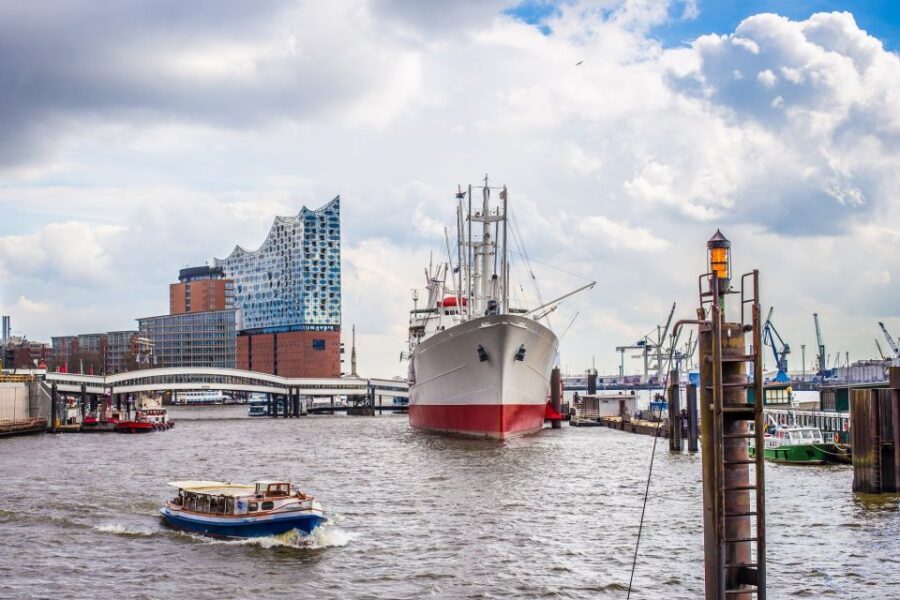
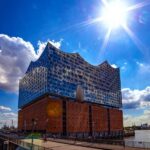
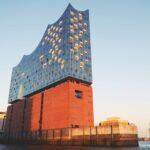
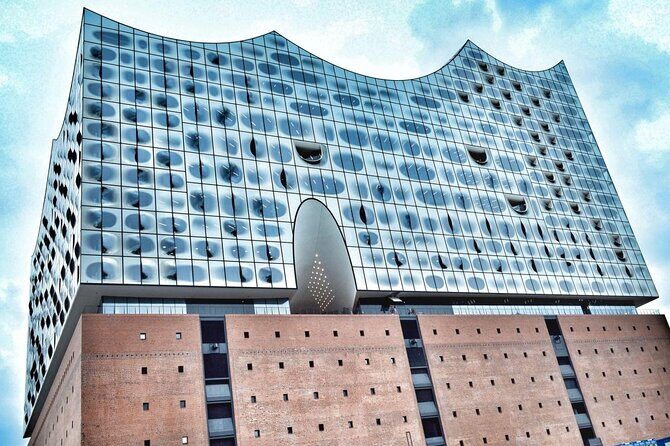
The tour ends right at the Elbphilharmonie. This is your final payoff, and the timing is good: after walking from old trading streets through regeneration and restoration, you reach a landmark that represents Hamburg’s present-day cultural ambition.
A few facts the guide shares help anchor it:
- The concert hall was inaugurated in 2016
- The first concert took place on 11 January 2017
- The tour ends in front of the building with an opportunity to visit the platform and enjoy the view over the port
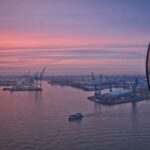
That platform view is the kind of thing you’ll feel even if you don’t go inside for a concert. It pulls the whole walk together. You look out at the harbor you heard about earlier—ships, shipping changes, and the city’s ongoing relationship with water—and it all starts to click.
One small consideration: this is the end point, so if you’re planning to go somewhere else right after, check your route out in advance. It’s easy to get caught up looking over the railings, especially if the light is good.
Price and timing: what you’re really paying for
At $30.04 per person for about two hours, this tour isn’t competing with museums on price. It’s a different value proposition. You’re paying mainly for the professional guide who connects multiple neighborhoods and explains the why behind what you’re seeing.
A big plus for value: key stops are described with free admission elements, like the Town Hall area and the sights you pass along. That means you’re not stacking your day with ticket costs on top of the tour fee. You’re investing in interpretation—someone taking scattered sights and turning them into a single narrative.
Timing-wise, it runs in a small window and tends to be booked about 89 days in advance on average. That’s a sign the route is popular, but it also means you’re likely to find dates if you plan ahead.
Group size is capped at 15, which usually makes a difference. In a bigger group, you miss more. Here, you can actually follow along and still take in the street-level details.
Who gets the most out of this tour?
- First-time visitors who want a structured Hamburg overview without wasting time
- People who enjoy city history explained through places, not through long lectures
- Travelers who like port cities and want more than boats in the distance
- Anyone who plans to spend time later in Speicherstadt and HafenCity and wants better context first
Weather, pace, and how to get the best out of the walk
The tour runs in all weather conditions, so think like a local: layers and shoes that handle cobbles and sidewalks. Hamburg weather can change fast, and you’ll be moving long enough that you don’t want restrictive footwear.
Pace-wise, this is a compact route. The stops are short, often 5–15 minutes, which is great for energy and getting oriented. It also means you’ll need to choose when to slow down for photos. If you want extra time at Speicherstadt or at the Elbphilharmonie platform, plan to add that on after the tour.
Language is English, so you won’t be worrying about translation gaps. Confirmation arrives at booking time, and you use a mobile ticket, which is convenient if your day is packed.
One more note: service animals are allowed, and the starting area is near public transportation, which helps if you’re combining this with other Hamburg plans.
If you get Jutta as your guide, you’ll feel the difference
The strongest praise tied to this experience is the guide experience. One guide named Jutta has been described as funny, knowledgeable, and good company, with history presented through stories and quick facts that land well with a group.
That matters more than you might think. In a city with so many layers—port commerce, WWII scars, UNESCO preservation, and modern architecture—your guide is the filter. A strong guide keeps the walk from becoming a checklist.
So if you see a guide name listed that you’re hoping for, that’s one reason to book confidently.
Should you book this Hamburg walking tour?
Yes, I’d book it if you want a smart, efficient way to connect Hamburg Town Hall, the merchant/port streets around Trostbrücke and Deichstraße, the reflective stop at St. Nikolai, and then the modern story of HafenCity and Speicherstadt—ending with Elbphilharmonie and port views.
Skip it only if you dislike walking close to 2 hours with short stop times. This isn’t a slow wander where you can linger for long museum-style reading breaks. It’s built for momentum and clarity.
If your ideal day is one where you come away thinking, I understand Hamburg’s flow now—this is a very solid match for that.
FAQ
How long is the tour?
It’s about 2 hours long.
Where does the tour start and end?
It starts at Rathausmarkt, 20095 Hamburg, Germany and ends at Elbphilharmonie, HamburgPlatz d. Deutschen Einheit 4, 20457 Hamburg, Germany.
What language is the tour offered in?
The tour is offered in English.
Do I need printed tickets?
No. You get a mobile ticket.
How big are the groups?
There’s a maximum of 15 travelers per tour, and a minimum of 8 for the booking to run.
Does the tour run in bad weather?
Yes. It operates in all weather conditions.
What’s included in the price?
A professional guide is included.
Can I cancel for a full refund?
Yes. Free cancellation is available if you cancel up to 24 hours before the experience starts for a full refund.